At Eleven, the Guns Fell Silent
Personal Column 52 · 11 November 2026 · Ad Latjes
In memoriam
At eleven in the morning on 11 November 1918, the Armistice took effect on the Western Front. In Belgium, we still set aside this day to remember. The fighting there stopped at an hour we can name. For millions of families, the loss went on for the rest of their lives. Imperial War Museums
Today I remember everyone who died in the First World War. The soldiers on every side, including those brought from far beyond Europe. The nurses, medical workers and civilians who died. The children killed in their own towns, and those who died from hunger or disease as the war tore apart the places they lived. I remember those whose names are carved in stone, those who have no known grave, and those whose families never learned what happened to them.
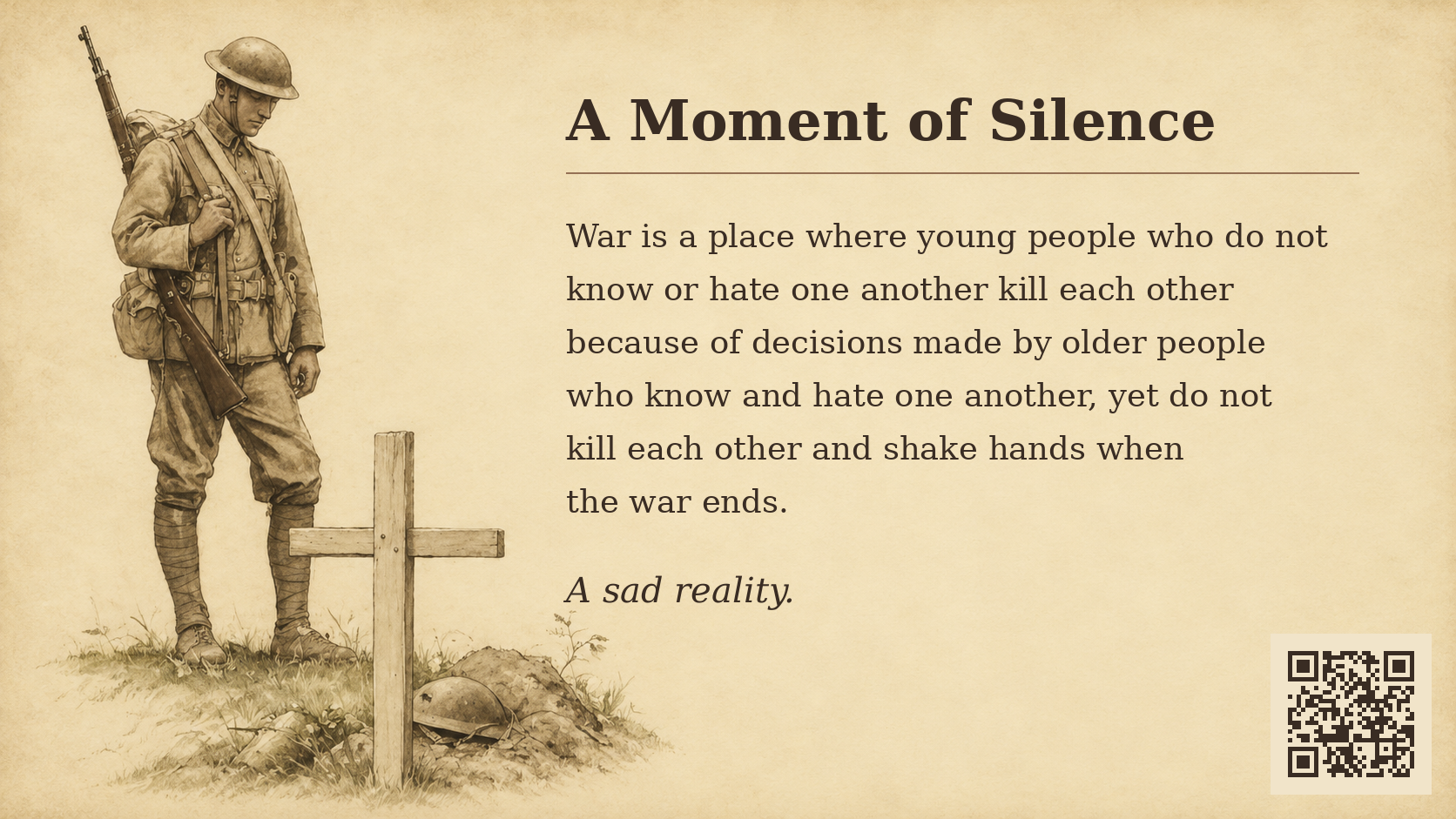
The translated illustration below shows a soldier standing beside a simple wooden cross. It asks us to think about two young people who have never met and have no personal reason to hate each other. Decisions made far away bring them face to face. The people who made those decisions may one day shake hands. The two young people may never go home.
Why do wars start?
On 28 June 1914, Archduke Franz Ferdinand was assassinated in Sarajevo. A month later, with German encouragement, Austria-Hungary declared war on Serbia. The crisis widened as governments made decisions about alliances, mobilisation and military action. Germany invaded neutral Belgium on its way to France. Each of those decisions had people behind it. Remembering that matters when we talk about Europe being swept into war. Imperial War Museums
Wars can begin with an attempt to seize territory, a fear that a rival will grow stronger, or a belief that victory will come quickly. Political scientist James Fearon asked a further question. If war is so costly, why do governments sometimes fail to reach a deal they could both live with? One answer is that each side knows things about its own strength and resolve that the other can only guess at, and has reasons to bluff. Another is that a government may doubt a rival will keep its promise once it has grown stronger. A deal can look possible on paper and still seem too risky to sign. James Fearon
What do the leaders have in common?
Research suggests that it matters who can challenge a leader before the decision is made. Political scientist Jessica Weeks found that authoritarian governments differ in how readily they start international conflicts. One important difference is whether people inside the regime have the power to restrain the leader. That makes me wonder what happens in the room when someone says the war will be over quickly. Who can ask them to explain how they know? Jessica Weeks
Personal experience may matter too. Michael Horowitz and Allan Stam studied the backgrounds of more than 2,500 leaders from 1875 to 2004. Former rebels and leaders who had served in the military without seeing combat were among those most likely to initiate militarised disputes and wars in their data. That historical pattern leaves open what any particular leader will do when the decision is theirs. Michael Horowitz and Allan Stam
I keep coming back to the handshake in the image. When the fighting stops, I’m glad someone is still there to shake hands. I just wish the people who finally sit down together could have imagined the families waiting for news before they gave the first order.
Today, the silence is for those families and for everyone who never came home.