How Social Are Social Media?
Perhaps the most social thing a phone can do is help us put it away.
Watch Adriana sing “I Am Adriana, I Am Ready to Talk” ↓ · 3 minutes 48 seconds
I sit alone at a café and look around.
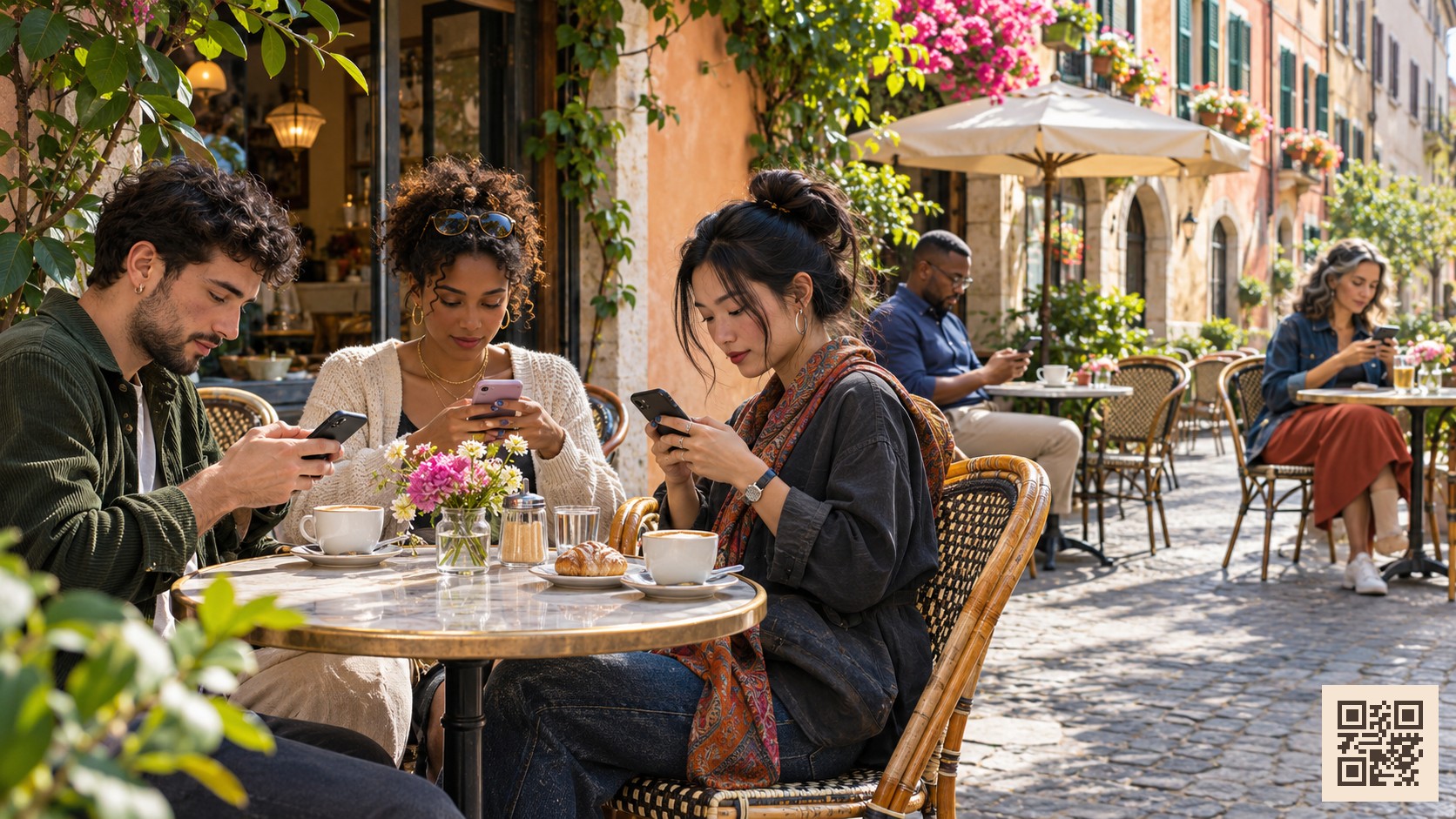
At one table, three people sit together. Each is looking at a phone. At another table, someone has come in alone and started scrolling. Three tables away, another person does the same.
Are those two people busy? Are they enjoying a little peace? Or would both welcome a conversation?
I cannot tell. Neither can they.
Last century, I could enter a neighbourhood café on my own and usually find someone to talk with. Many of those cafés have disappeared. Now we can contact someone on the other side of the world in seconds, while finding it difficult to say hello to someone across the room.
Social media do bring people together. I can keep in touch with friends in Costa Rica while I am in Belgium. A photograph can revive a memory; a message can tell a distant friend that I still care.
But something else has happened alongside that progress. Across 21 European OECD countries, 21% of people reported meeting friends in person every day in 2006. In 2022, it was 12%. Daily remote contact with friends rose from 24% to 28%. That does not prove social media caused the decline. It does show that more contact on a screen has not preserved the old frequency of meeting face to face. [1]
I do not want to blame the person looking at a phone. Perhaps they are working. Perhaps they are arranging to meet a friend. Perhaps they would love to talk but have no idea whether the person three tables away feels the same.
That uncertainty is familiar to anyone who has travelled alone, moved to a new town, worked from home or retired. Having time for a conversation does not automatically give you someone to share it with.
What can we do? We can make cafés welcoming to people who come alone. We can invite a neighbour for coffee. We can organise small local activities where saying hello feels natural.
And perhaps a phone can help, too.
In an earlier column, I imagined an app called Ready to Talk. You could indicate that you had time, choose subjects you enjoyed discussing, and find someone nearby who also wanted a conversation. A shared interest would give you somewhere to begin. Both people could decide whether to meet in a public place.
The most useful thing such an app could tell two strangers is simple: the conversation is welcome.
There is no obligation to flirt, become friends or spend the whole afternoon together. A twenty-minute conversation over coffee can be worthwhile on its own. And being ready to talk must never mean being obliged to talk; either person must be free to decline or leave.
When I wrote that earlier column, Ready to Talk was a concept. Now the app has been created at ready-to-talk.app. It is too soon to claim it has changed anyone’s social life. The real test is whether people use it to have conversations they otherwise would have missed.
Visit Ready to Talk →
https://ready-to-talk.app
Perhaps the person three tables away wants to be alone. Perhaps they would like to tell me about the place they have just visited. I would rather let them choose than make assumptions from the sight of a phone.
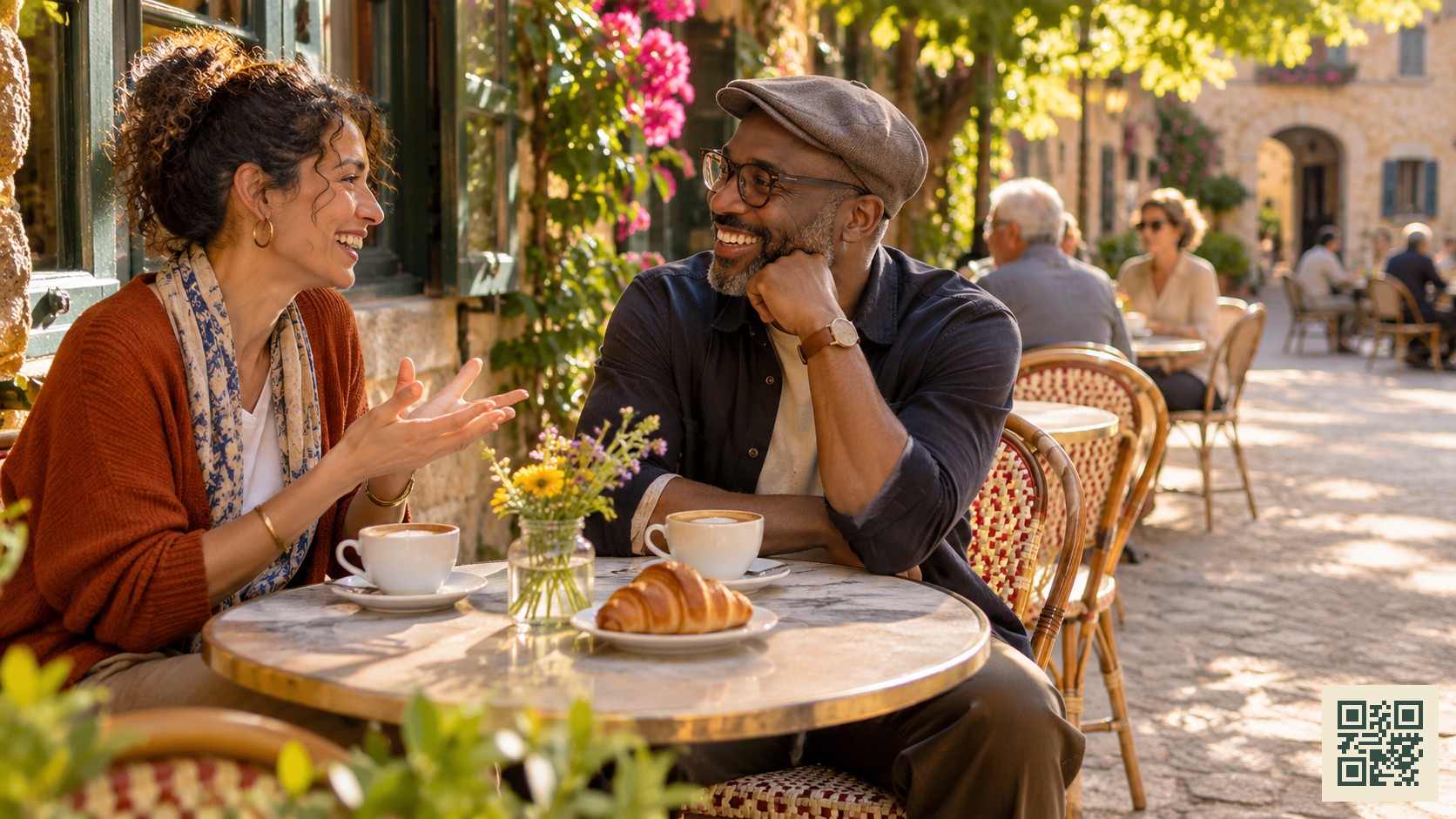
We have spent twenty years making it easier to connect online. Let us also make it easier for two willing people to meet across a café.
Perhaps the most social thing a phone can do is help us put it away.
Lees deze column in het Nederlands +
Hoe sociaal zijn sociale media?
Misschien is het sociaalste wat een telefoon kan doen ons helpen hem weg te leggen.
Bekijk Adriana’s lied “I Am Adriana, I Am Ready to Talk” ↓ · 3 minuten 48 seconden
Ik zit alleen in een café en kijk om me heen.
Aan één tafel zitten drie mensen bij elkaar. Ieder kijkt naar een telefoon. Aan een andere tafel is iemand alleen binnengekomen en begonnen te scrollen. Drie tafels verder doet iemand anders hetzelfde.
Zijn die twee mensen druk? Genieten ze van een rustig moment? Of zouden ze allebei graag een gesprek voeren?
Ik weet het niet. Zij weten het ook niet van elkaar.
Vorige eeuw kon ik alleen een buurtcafé binnenlopen en meestal wel iemand vinden om mee te praten. Veel van die cafés zijn verdwenen. Nu kunnen we in enkele seconden iemand aan de andere kant van de wereld bereiken, maar vinden we het soms moeilijk iemand aan de andere kant van het café aan te spreken.
Sociale media brengen mensen ook echt samen. Vanuit België kan ik contact houden met vrienden in Costa Rica. Een foto kan een herinnering terugbrengen; een bericht kan een verre vriend laten weten dat ik nog aan hem denk.
Maar tegelijk is er iets anders gebeurd. In 21 Europese OESO-landen zei 21% van de mensen in 2006 elke dag vrienden persoonlijk te ontmoeten. In 2022 was dat 12%. Dagelijks contact met vrienden op afstand steeg van 24% naar 28%. Dat bewijst niet dat sociale media de daling veroorzaakten. Het laat wel zien dat meer contact via een scherm de vroegere frequentie van persoonlijke ontmoetingen niet heeft behouden. [1]
Ik wil niemand verwijten dat hij op zijn telefoon kijkt. Misschien werkt hij. Misschien spreekt hij af met een vriend. Misschien wil hij juist praten, maar weet hij niet of de persoon drie tafels verder daar ook zin in heeft.
Wie alleen reist, naar een nieuwe stad verhuist, thuiswerkt of met pensioen gaat, kent die onzekerheid misschien. Tijd hebben voor een gesprek betekent nog niet dat je iemand hebt om die tijd mee te delen.
Wat kunnen we doen? Cafés kunnen bezoekers die alleen komen welkom laten voelen. We kunnen een buur uitnodigen voor koffie. We kunnen kleine activiteiten organiseren waar een gesprek vanzelf begint.
En misschien kan een telefoon ook helpen.
In een eerdere column bedacht ik een app: Ready to Talk. Je geeft aan dat je tijd hebt, kiest onderwerpen waarover je graag praat en ziet of iemand in de buurt ook openstaat voor een gesprek. Een gezamenlijke interesse geeft je een begin. Beiden kunnen besluiten of ze op een openbare plek willen afspreken.
Het belangrijkste wat zo’n app aan twee onbekenden kan vertellen, is eenvoudig: een gesprek is welkom.
Niemand hoeft te flirten, vrienden te worden of de hele middag samen door te brengen. Twintig minuten praten bij een kop koffie kan op zichzelf al fijn zijn. En klaar zijn om te praten mag nooit betekenen dat je verplicht bent te praten; allebei moeten ze vrij zijn om nee te zeggen of weg te gaan.
Toen ik die eerdere column schreef, was Ready to Talk nog een idee. Nu is de app gemaakt en bereikbaar op ready-to-talk.app. Het is te vroeg om te beweren dat de app al iemands sociale leven heeft veranderd. De echte proef is of mensen er gesprekken door voeren die anders nooit hadden plaatsgevonden.
Bezoek Ready to Talk →
https://ready-to-talk.app
Misschien wil de persoon drie tafels verder graag alleen zijn. Misschien wil diegene me vertellen over de plek waar hij of zij net is geweest. Ik geef liever ruimte voor een keuze dan dat ik conclusies trek uit een blik op een telefoon.
We hebben twintig jaar gewerkt aan makkelijker online contact. Laten we het ook makkelijker maken voor twee mensen die dat willen om elkaar in een café te ontmoeten.
Misschien is het sociaalste wat een telefoon kan doen ons helpen hem weg te leggen.
Sources / Bronnen
- OECD (2025) · Social Connections and Loneliness in OECD Countries · trends in 21 European countries, 2006–2022
- Ad Latjes · Ready to Talk? · earlier concept column
The OECD percentages refer to the share who meet friends in person every day, not the total number of conversations. The data do not establish social media as the cause of the decline. The café photographs are illustrations, not documentary images. Adriana Carmen is a virtual singer.
Free-to-download images
Download these illustrated images. Their small QR codes point to https://va.cr/66.
Download JPG
Download JPG

Download JPG
Wear it. See these images on a T-shirt
Adriana Carmen · I Am Adriana, I Am Ready to Talk
Adriana sings about a sunny café, a shared interest and the joy of putting down the phone for a real conversation. The big chorus invites everyone to sing along.