Geopolitics Explained for Beginners, Without Jargon
October 25, 2026
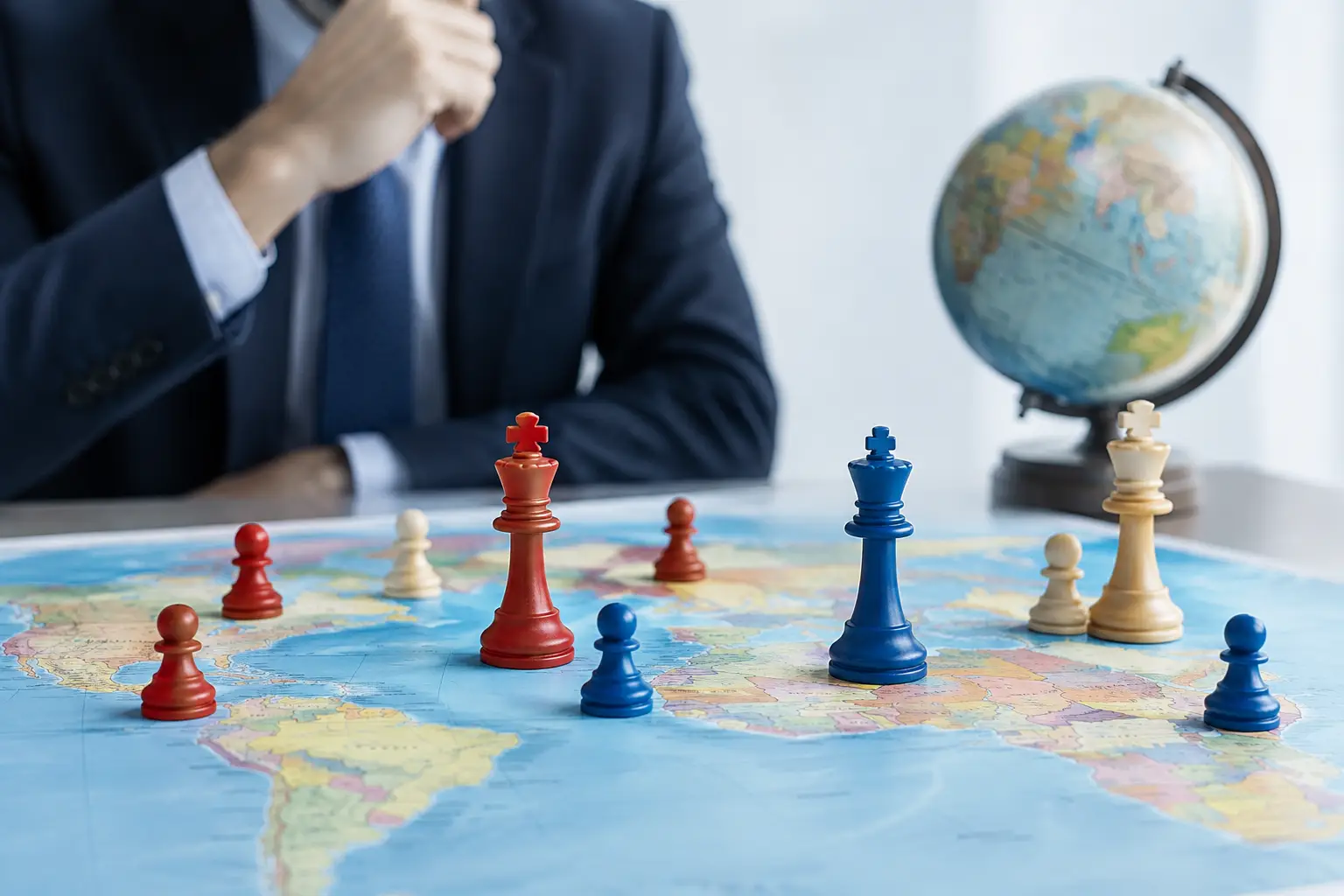
A cargo ship stuck near a narrow waterway can make your groceries pricier. A drought in one region can unsettle elections in another. A president’s handshake, a new chip factory, or a pipeline across a border can matter more than a dozen speeches. That is geopolitics explained for beginners: not a secret club for men pointing at maps, but the practical study of who has power, what they need, and where geography gets in the way.
The word sounds intimidating because it is usually delivered with grave faces, red arrows, and a map large enough to hide behind. But the basic idea is pleasantly human. Countries, like people, have interests. They want security, income, influence, and reliable access to the things that keep life running. The complication is that countries have armies, ports, borders, history, and occasionally an alarming amount of natural gas.
Geopolitics Explained for Beginners: Start With Interests
Geopolitics is the relationship between geography and political power. Geography includes obvious things such as mountains, rivers, seas, climate, and neighboring countries. It also includes less postcard-worthy realities: shipping lanes, oil fields, rare-earth mines, fertile land, undersea internet cables, and factories that make advanced computer chips.
Politics is what governments do with those conditions. A country surrounded by friendly trading partners has different choices from one with a hostile neighbor, a long coastline to defend, and one narrow road to the outside world. Neither country is “good” or “bad” because of its map. But its map does influence what leaders fear, what they can sell, and which alliances look attractive.
Start by asking a stubbornly simple question: what does each player want? Usually, the answer falls somewhere between safety, prosperity, status, and domestic political survival. Leaders also want to stay in office, which can produce decisions that make strategic sense for next month’s election and very little sense for the next decade. This is not a bug in geopolitics. It is one of the main features.
A useful example is energy. A country that imports most of its oil or gas is vulnerable when supplies are disrupted or prices jump. It may build relationships with suppliers it does not particularly admire. A country that exports energy gains revenue and leverage, but can become dangerously dependent on high prices. Everyone talks about principles until the heating bill arrives, then principles are often asked to wait in the hallway.
Power Is More Than Tanks and Missiles
Military power matters. Ignoring it would be like judging a neighborhood entirely by its bakeries while overlooking the man revving a bulldozer outside. Yet tanks are only one form of influence.
Economic power can be just as decisive. Large markets can set rules that companies around the world must follow. Control over finance can make it difficult for another country to trade, borrow, or move money. Technology matters because a modern economy depends on software, data centers, chips, satellites, and the materials needed to make them. Food matters because hungry populations are not famous for their patience.
There is also soft power: the ability to attract rather than force. A country with respected universities, popular culture, reliable institutions, and a reputation for keeping its word can persuade others to cooperate. Soft power is easy to mock until you notice how many people prefer to do business, study, invest, or seek refuge in places they trust.
The catch is that power is contextual. A small country located on a critical shipping route may have influence far beyond its population. A wealthy country may be militarily strong but vulnerable because it imports key components. A giant country may have enormous resources but poor roads, weak institutions, or leaders who mistake fear for loyalty. Geopolitics has no universal league table, however much television graphics would like one.
Why Borders and Bottlenecks Matter
Maps tempt us to think in colors: this land belongs to that country, end of discussion. Real borders are often stories frozen in place. They may reflect old wars, colonial decisions, ethnic communities, rivers that moved, or a line drawn by someone who had never visited and was late for lunch.
That does not mean borders are unimportant. Quite the opposite. Borders determine laws, taxes, security, citizenship, and access to resources. When groups disagree over a border, the dispute can become emotionally explosive because territory is rarely just territory. It can represent identity, memory, safety, or a family history stretching back generations.
Then there are chokepoints: narrow places through which a great deal of trade or military movement must pass. Think of sea lanes, canals, mountain passes, and a handful of straits. When a chokepoint is blocked, threatened, or controlled by an unfriendly power, the effects travel quickly through supply chains. A delayed container is not merely a delayed container when it carries a part needed for a factory that supplies another factory. Global trade is impressively efficient right up to the moment it is not.
This is why faraway conflicts can show up in local life. They affect fuel, insurance, shipping, food, migration, investment, and public confidence. The connection is not always immediate, and commentators can overstate it. Still, the notion that foreign affairs stay politely abroad is a luxury few economies can afford.
Alliances Are Insurance Policies, Not Friendships
Countries make alliances because alone is expensive. An alliance can deter aggression, share intelligence, coordinate trade, or create common standards. It can also limit freedom of action. If your allies expect support during a crisis, you may be pulled into arguments you did not start and cannot easily finish.
This is why alliances are best understood as insurance policies. You hope not to use them. You pay for them through commitments, defense spending, diplomatic compromise, and sometimes uncomfortable conversations with partners whose domestic politics make your eyes roll. But when danger rises, being part of a credible group can change the calculation of an opponent.
Credibility is the awkward word here. A promise only deters if others believe it will be kept. Governments therefore spend a great deal of time signaling resolve. They hold exercises, move ships, impose sanctions, visit capitals, and issue statements that sound as if they were written by a committee trapped in an elevator. Behind the formal language is a blunt message: test us, and there will be a cost.
How to Read Geopolitical News Without Becoming a Cynic
The beginner’s mistake is to search for a single villain, a single cause, or a single master plan. Sometimes leaders are plainly reckless or cruel. Moral clarity matters. But understanding a conflict requires more than assigning cartoon roles before the first commercial break.
When a major event occurs, ask a few questions. What is at stake materially: security, territory, trade, resources, technology, or political survival? Which geographic facts constrain the choices? Who benefits if the situation continues, and who pays the price? What does each side fear losing? Finally, what might change the incentives?
That last question is often more useful than predicting who will “win.” Conflicts end, freeze, escalate, or transform when costs become unbearable, leadership changes, allies shift, economies weaken, or a previously unthinkable compromise becomes less painful than carrying on. None of this makes compromise easy. It merely explains why slogans are rarely a foreign policy.
Be wary of the word “inevitable.” History is full of events that look inevitable only after they happened. Leaders make choices. Voters make choices. Businesses decide where to invest. A ship captain changes route. A small technical innovation changes what is possible. Geography sets the stage, but it does not write every line of the script.
The Geopolitics in Your Pocket
Your phone is a compact geopolitical object. Its components may rely on minerals mined in one region, chips produced in another, software developed elsewhere, and shipping routes protected by navies you never think about until there is trouble. The same is true for electric cars, medicines, solar panels, wheat, and the cloud that supposedly lives nowhere in particular. It lives in buildings, uses electricity, and sits under somebody’s laws.
This does not mean every purchase requires a degree in international relations. It does mean that geopolitical awareness is no longer a hobby for diplomats. For entrepreneurs, it affects suppliers and regulation. For workers, it affects jobs and prices. For voters, it affects the promises governments can realistically keep.
The useful habit is not panic, and certainly not treating every headline as the opening scene of World War III. It is curiosity with a calculator nearby. Ask what is changing, who depends on whom, and whether the loudest explanation is also the most plausible one.
A map will never tell you everything. People can cooperate across mountains, squander abundance, and turn minor disputes into disasters through vanity alone. But when the next distant crisis appears on your screen, look for the interests, the routes, the dependencies, and the fears beneath the speeches. The world will not become simpler, but it may become a little less mysterious.