Nederland zet Tata Steel nog even op snooze
Nederland heeft een oplossing gevonden voor de toekomst van Tata Steel.
We stellen de oplossing uit.
De beslissing die uiterlijk 30 september 2026 genomen moest worden, komt nu pas op 1 maart 2027. Een halfjaar extra onderhandelen. Dat klinkt daadkrachtiger wanneer je het “zorgvuldigheid” noemt.
Nederland is tenslotte het land waar zelfs uitstel eerst uitgebreid wordt voorbereid.
Het probleem is niet dat er te weinig belangen zijn. Het probleem is juist dat we ze allemaal tegelijk willen beschermen.
We willen staal produceren, maar geen vervuiling.
We willen 9.000 banen bij Tata Steel behouden, plus ongeveer 20.000 banen bij bedrijven die ervan afhankelijk zijn.
We willen de gezondheid van de mensen in de IJmond beschermen.
We willen minder CO₂ uitstoten.
We willen niet afhankelijk worden van staal uit China, India of andere landen.
En we willen vooral niet te veel betalen.
Kortom: we willen een grote staalfabriek die veel produceert, niemand ziek maakt, geen CO₂ uitstoot, duizenden mensen werk geeft en zichzelf gratis verbouwt.
Dat is geen industriebeleid.
Dat is een verlanglijstje voor Sinterklaas.
Tata Steel is de grootste uitstoter van broeikasgassen in Nederland. Het verduurzamingsplan moet de uitstoot met ongeveer veertig procent verminderen. De helft van de huidige hoogovens zou plaatsmaken voor een productieproces dat op gas en later op waterstof kan draaien.
Dat klinkt goed.
Tot iemand vraagt wat het kost.
Dan begint in Den Haag het traditionele Nederlandse ritueel: onderzoeken, overleggen, herberekenen, nieuwe voorwaarden stellen en uiteindelijk besluiten dat er meer tijd nodig is om te onderzoeken waarom het onderzoek nog niet tot een besluit heeft geleid.
Ondertussen wonen er gewoon mensen naast de fabriek.
Zij hoeven geen beleidsnota te lezen om te weten dat Tata Steel bestaat. Ze kunnen het soms ruiken, zien en vermoedelijk ook van hun vensterbank afvegen.
De kooksgasfabrieken zouden structureel meer gevaarlijke stoffen uitstoten dan is toegestaan. De omgevingsdienst overweegt daarom vergunningen in te trekken. Bovendien heeft het Openbaar Ministerie besloten Tata Steel strafrechtelijk te vervolgen wegens het volgens justitie opzettelijk uitstoten van stoffen die gevaarlijk zijn voor omwonenden.
Dat maakt de onderhandelingen enigszins ongemakkelijk.
De overheid zit aan tafel met een bedrijf waaraan zij mogelijk miljarden steun wil geven, terwijl een andere arm van diezelfde overheid zegt: wij denken dat u bewust gevaarlijke stoffen heeft uitgestoten.
In Nederland noemen we dat geen tegenstrijdigheid.
Wij noemen dat integraal beleid.
Toch is het te eenvoudig om te zeggen: sluit die fabriek maar.
Staal verdwijnt namelijk niet wanneer Nederland stopt met de productie. We blijven bruggen bouwen, spoorrails vervangen, windmolens plaatsen, auto’s maken en defensiematerieel bestellen. Als het staal niet uit IJmuiden komt, komt het ergens anders vandaan.
Waarschijnlijk uit een land waar de uitstoot niet lager is, de arbeidsvoorwaarden niet beter zijn en Nederlandse inspecteurs aanzienlijk minder indruk maken.
Dan hebben wij schone handen omdat een ander land onze vuile handen heeft overgenomen.
Dat is een populaire Europese klimaatstrategie: de fabriek verdwijnt uit beeld, de producten blijven binnenkomen en de uitstoot krijgt een buitenlands adres.
We importeren daarna hetzelfde staal per schip en feliciteren onszelf met de daling van de Nederlandse uitstoot.
De CO₂ krijgt onderweg vermoedelijk geen paspoortcontrole.
Tata Steel behouden kan daarom verstandig zijn. Europa moet essentiële producten zelf kunnen maken. De afgelopen jaren hebben laten zien dat volledige afhankelijkheid van andere werelddelen goedkoop lijkt, totdat er een oorlog uitbreekt, een vaarroute wordt afgesloten of een buitenlandse regering besluit dat levering voortaan onderdeel is van een politiek onderhandelingsspel.
Maar strategische onafhankelijkheid mag geen magische zin worden waarmee iedere subsidie automatisch wordt goedgekeurd.
Een bedrijf kan niet zeggen: “Wij zijn essentieel voor Nederland, dus Nederland is essentieel voor onze bankrekening.”
Als Tata Steel miljarden aan publiek geld ontvangt, moet daar een publiek contract tegenover staan dat door een normaal mens te begrijpen is.
Geen stapel documenten waarin “inspanning”, “ambitie” en “streven” honderden keren voorkomen, terwijl het woord “garantie” ergens achterin een voetnoot staat.
Maak concrete afspraken.
Hoeveel gevaarlijke uitstoot verdwijnt er?
Op welke datum?
Hoeveel CO₂ wordt werkelijk bespaard?
Welke installaties gaan dicht?
Wat gebeurt er wanneer een doel niet wordt gehaald?
En welk deel van de subsidie moet dan worden terugbetaald?
Publiceer die resultaten iedere maand op een eenvoudige website. Groen als een doel is gehaald, oranje als er vertraging is en rood als er opnieuw een werkgroep is opgericht.
Laat Tata Steel bovendien zelf financieel risico dragen.
Overheidssteun hoeft niet alleen een cadeau te zijn. Nederland kan aandelen nemen, leningen verstrekken die moeten worden terugbetaald of betalingen pas vrijgeven nadat aantoonbare resultaten zijn bereikt.
Eerst minder uitstoot, dan de volgende betaling.
Dat systeem werkt bij het verbouwen van een badkamer en zou daarom ook bruikbaar moeten zijn bij het verbouwen van de grootste staalfabriek van Nederland.
Reserveer daarnaast vanaf het begin geld voor de werknemers.
Niet alleen voor de directie, consultants en technische installaties, maar voor opleiding, omscholing en inkomenszekerheid van mensen wier werk verandert of verdwijnt.
Politici zeggen graag dat werknemers “centraal staan”. Meestal betekent dit dat zij centraal op de foto mogen staan wanneer het akkoord wordt ondertekend.
Echte zekerheid is iets anders.
Echte zekerheid betekent dat een werknemer nu al weet wat er met hem gebeurt wanneer zijn installatie over drie jaar wordt gesloten.
Ook de inwoners van de IJmond verdienen meer dan vriendelijke woorden. Geef onafhankelijke gezondheidsmetingen, realtime inzicht in uitstoot en een vaste vertegenwoordiging van bewoners bij de uitvoering van het akkoord.
Wie dagelijks naast de fabriek woont, moet niet pas geïnformeerd worden nadat de minister en de directie samen de persconferentie hebben voorbereid.
En dan is er nog de belangrijkste vraag: wat wil Nederland eigenlijk met zijn industrie?
We kunnen niet bij ieder afzonderlijk bedrijf jarenlang improviseren. Nederland en Europa moeten bepalen welke productie strategisch noodzakelijk is, hoeveel schone energie daarvoor beschikbaar komt en onder welke voorwaarden de samenleving meebetaalt.
Staal, chemie, medicijnen, chips, energie en defensiematerieel zijn geen losse dossiers. Ze vormen samen de industriële basis van een continent.
Zonder zo’n plan verandert ieder groot bedrijf in een nationale spoedvergadering.
De fabriek zegt dat duizenden banen verdwijnen.
De overheid schrikt.
Consultants maken een presentatie.
En zes maanden later wordt bekendgemaakt dat er meer tijd nodig is.
Misschien is het uitstel tot 1 maart 2027 verdedigbaar. Een besluit van miljarden euro’s hoeft niet tijdens een haastige vergadering op maandagmiddag te worden genomen.
Maar uitstel is alleen verstandig wanneer er in die extra tijd iets wordt opgelost.
Een deadline verplaatsen is nog geen beleid.
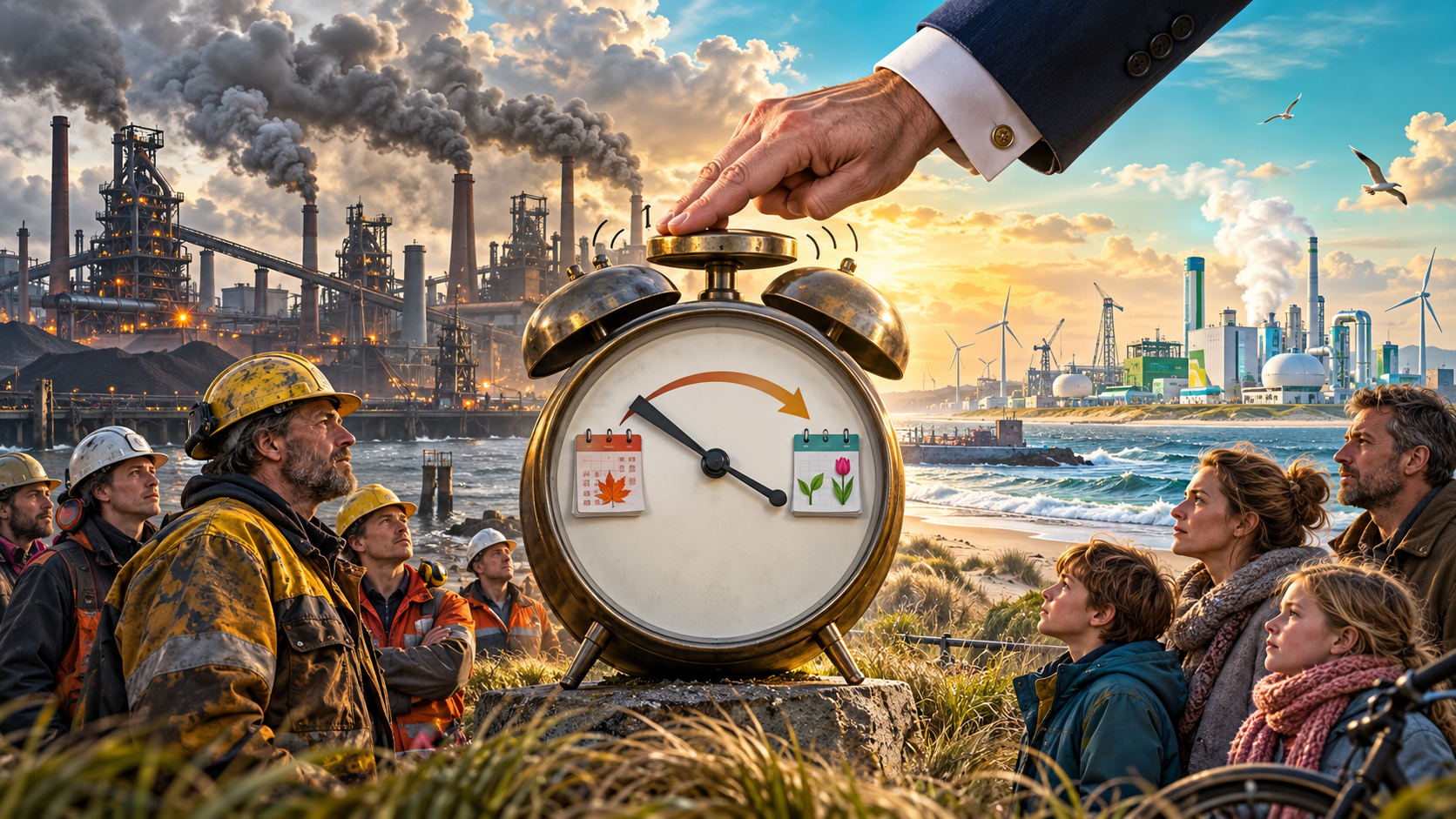
Een wekker die zes maanden later afgaat, lost het probleem niet op. Hij geeft ons alleen zes maanden extra om te bedenken waarom we hem straks opnieuw willen uitzetten.
Nederland zal uiteindelijk moeten kiezen.
Niet tussen banen óf gezondheid.
Niet tussen industrie óf klimaat.
Maar voor een moderne staalindustrie die alleen bestaansrecht heeft wanneer zij aantoonbaar schoner wordt, werknemers perspectief geeft en de omgeving niet langer vraagt om de prijs met haar gezondheid te betalen.
Dat kost geld.
De fabriek sluiten kost ook geld.
Niets beslissen lijkt voorlopig gratis.
Daarom is het in Den Haag meestal de aantrekkelijkste optie.
Tot 1 maart 2027 tenminste.
Dan gaat de wekker opnieuw.
The Netherlands Puts Tata Steel on Snooze Again
The Netherlands has found a solution for the future of Tata Steel.
We are postponing the solution.
The decision that was supposed to be made by 30 September 2026 will now not arrive until 1 March 2027. Another six months of negotiations. It sounds more decisive when you call it “due care.”
After all, the Netherlands is the country where even a delay must first be thoroughly prepared.
The problem is not that too few interests are involved. The problem is that we want to protect all of them at the same time.
We want to produce steel, but without pollution.
We want to preserve 9,000 jobs at Tata Steel, plus approximately 20,000 jobs at companies that depend on it.
We want to protect the health of people living in the IJmond region.
We want to emit less CO₂.
We do not want to become dependent on steel from China, India or other countries.
And above all, we do not want to pay too much.
In short, we want a large steelworks that produces a great deal, makes nobody ill, emits no CO₂, employs thousands of people and rebuilds itself free of charge.
That is not industrial policy.
It is a wish list for Saint Nicholas.
Tata Steel is the largest emitter of greenhouse gases in the Netherlands. The sustainability plan is intended to reduce emissions by approximately 40 percent. Half of the current blast furnaces would be replaced by a production process running first on gas and later on hydrogen.
That sounds good.
Until somebody asks what it will cost.
Then the traditional Dutch ritual begins in The Hague: investigate, consult, recalculate, impose new conditions and ultimately decide that more time is needed to investigate why the investigation has not yet produced a decision.
Meanwhile, people simply live next to the factory.
They do not need to read a policy document to know Tata Steel exists. Sometimes they can smell it, see it and probably wipe it from their windowsills.
The coke-gas plants are alleged to have consistently emitted more hazardous substances than permitted. The environmental authority is therefore considering withdrawing permits. In addition, the Public Prosecution Service has decided to prosecute Tata Steel for what prosecutors say was the deliberate emission of substances dangerous to local residents.
That makes the negotiations slightly uncomfortable.
The government is sitting at the table with a company to which it may provide billions in support, while another arm of that same government says: we believe you deliberately emitted hazardous substances.
In the Netherlands, we do not call that a contradiction.
We call it integrated policy.
Yet it is too easy simply to say: close the factory.
Steel does not disappear when the Netherlands stops producing it. We will continue building bridges, replacing railway tracks, installing wind turbines, manufacturing cars and ordering defence equipment. If the steel does not come from IJmuiden, it will come from somewhere else.
Probably from a country where emissions are no lower, employment conditions are no better and Dutch inspectors make considerably less of an impression.
We can then claim clean hands because another country has taken over our dirty ones.
It is a popular European climate strategy: the factory disappears from view, the products continue arriving and the emissions acquire a foreign address.
We then import the same steel by ship and congratulate ourselves on the reduction in Dutch emissions.
The CO₂ probably does not face passport control along the way.
Keeping Tata Steel may therefore be sensible. Europe must be capable of manufacturing essential products itself. Recent years have shown that complete dependence on other parts of the world appears inexpensive until a war erupts, a shipping route is blocked or a foreign government decides that deliveries are now part of a political bargaining game.
But strategic independence must not become a magic phrase that automatically approves every subsidy.
A company cannot say: “We are essential to the Netherlands, so the Netherlands is essential to our bank account.”
If Tata Steel receives billions in public money, there must be a public contract in return that an ordinary person can understand.
Not a stack of documents in which “effort,” “ambition” and “intention” appear hundreds of times while the word “guarantee” is hidden in a footnote near the back.
Make concrete agreements.
How much hazardous pollution will disappear?
By what date?
How much CO₂ will genuinely be saved?
Which installations will close?
What happens when a target is missed?
And what portion of the subsidy must then be repaid?
Publish the results every month on a simple website. Green when a target has been met, orange when there is a delay and red when yet another working group has been established.
Tata Steel must also bear financial risk itself.
Government support need not be merely a gift. The Netherlands can acquire shares, provide loans that must be repaid or release payments only after verifiable results have been achieved.
First lower the emissions, then receive the next payment.
That system works when renovating a bathroom and should therefore also be useful when rebuilding the largest steelworks in the Netherlands.
Money must also be reserved for workers from the very beginning.
Not only for management, consultants and technical installations, but for training, retraining and income security for people whose jobs will change or disappear.
Politicians like to say that workers “take centre stage.” Usually, this means they may stand in the centre of the photograph when the agreement is signed.
Real security is something else.
Real security means that a worker already knows what will happen to him when his installation closes three years from now.
The residents of the IJmond region also deserve more than kind words. Provide independent health measurements, real-time access to emissions data and permanent resident representation during implementation of the agreement.
People who live beside the factory every day should not be informed only after the minister and management have prepared their joint press conference.
And then there is the most important question: what does the Netherlands actually want from its industry?
We cannot improvise for years with every individual company. The Netherlands and Europe must determine which production is strategically essential, how much clean energy will be available for it and under what conditions society will contribute financially.
Steel, chemicals, medicines, chips, energy and defence equipment are not separate files. Together, they form the industrial foundation of a continent.
Without such a plan, every large company becomes a national emergency meeting.
The factory says thousands of jobs will disappear.
The government panics.
Consultants prepare a presentation.
And six months later, it is announced that more time is required.
Perhaps postponement until 1 March 2027 is defensible. A decision involving billions of euros need not be made during a rushed Monday-afternoon meeting.
But postponement is sensible only when something is resolved during the extra time.
Moving a deadline is not yet a policy.
An alarm clock that rings six months later does not solve the problem. It merely gives us another six months to think of reasons to switch it off again.
The Netherlands will eventually have to choose.
Not between jobs or health.
Not between industry or climate.
But in favour of a modern steel industry that has a right to exist only when it becomes demonstrably cleaner, gives workers a future and no longer asks the surrounding community to pay the price with its health.
That costs money.
Closing the factory costs money too.
Making no decision appears free for the time being.
That is why it is usually the most attractive option in The Hague.
At least until 1 March 2027.
Then the alarm clock rings again.
Actuele Nederlandse onderwerpen, telkens bekeken vanuit een persoonlijke en verrassende invalshoek.