Why Does My Money Need a Passport?
How did a 1976 telex and a motorcycle beat an international bank transfer in 2026?
Watch Adriana sing “The Money Protest Song” ↓ · 4 minutes 19 seconds
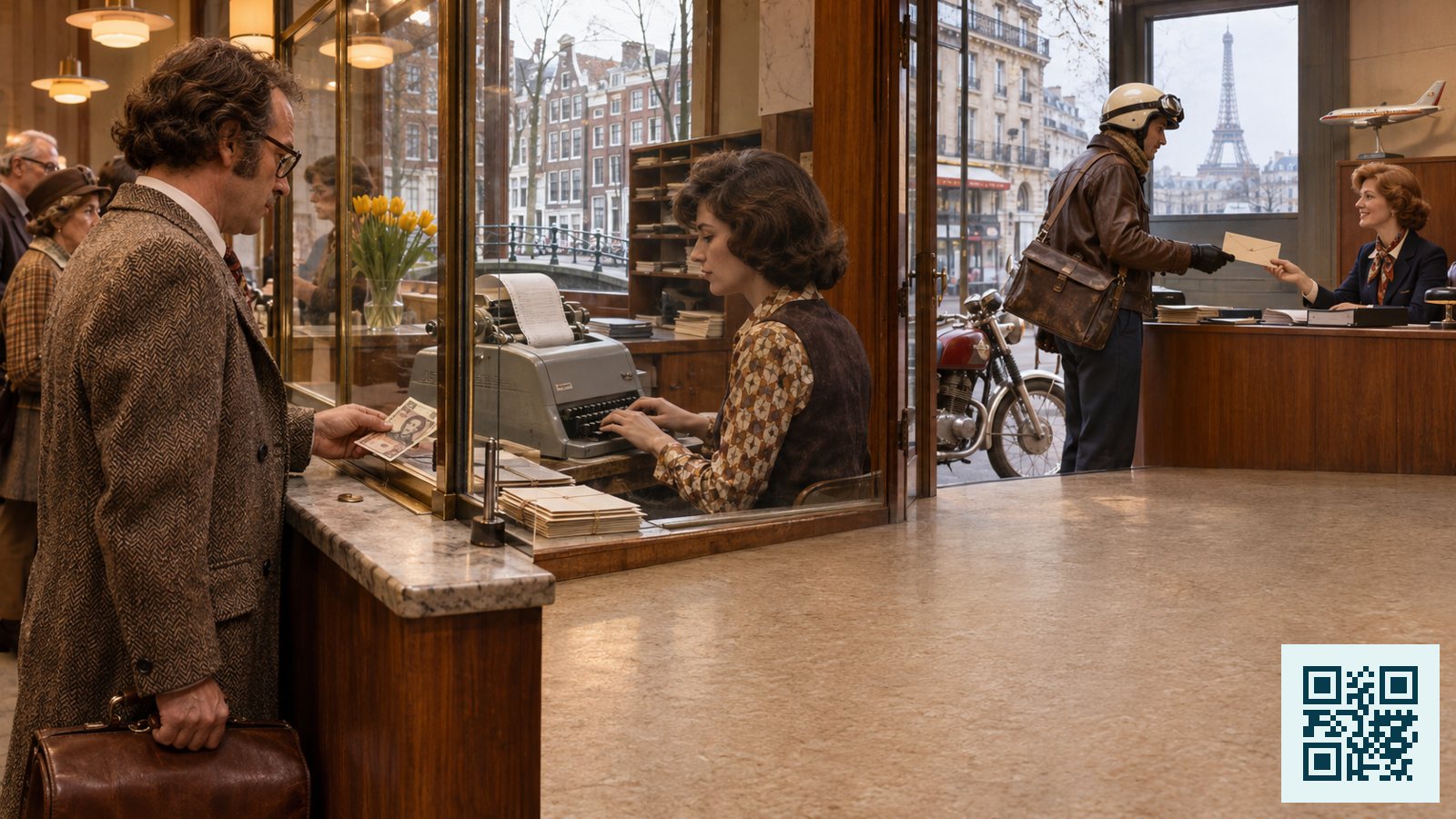
In 1976, I regularly had to pay airline offices in other European countries. Sometimes an office in Paris needed French francs while I was in Amsterdam with Dutch guilders.
I went to the post office, told the clerk how many francs the airline should receive, and paid the equivalent in guilders in cash.
The post office sent a telex to Paris. There, a courier took the francs by motorcycle to the airline office.
In my experience, the airline could have its money within an hour. I used similar arrangements hundreds of times for payments to Belgium, Britain, Germany and France.
There were no smartphones. No banking apps. Just people, a telex and someone willing to get on a motorcycle.
Today, I sometimes send money from the Netherlands to Costa Rica. Costa Rican accounts have IBAN numbers, and my payments usually arrive within six to eight business hours. That is much faster than the international transfers I remember from before Costa Rica adopted IBAN.
But an IBAN is an address for an account. It does not, by itself, provide the road that carries money between countries.
Within Costa Rica, its own SINPE system moves payments between accounts. Within much of Europe, SEPA makes euro transfers straightforward. Between those regions, banks still need arrangements to exchange currencies, transfer and settle the money, and apply rules that differ from country to country. [1] [2]
I understand that a bank cannot simply send a message saying, “The money is there.” The receiving bank must actually get paid. It must also know whom it is paying, deal with fraud and have a way to correct mistakes.
But surely these problems are meant to be solved, not offered indefinitely as an explanation for delay.
The technology to connect instant-payment systems already exists. The Bank for International Settlements has developed a plan for connecting national systems, and Europe is working on links between its own instant-payment infrastructure and systems beyond Europe. Yet a report published this month says that improvements experienced by customers remain slow and uneven. [3] [4] [5]
That leaves a question for governments, central banks and the payment industry:
What, exactly, is still stopping you?
If the obstacle is a rule, tell us which rule needs agreement. If it is a missing connection, tell us who must build it. If banks are reluctant to invest, tell us how they will be encouraged to participate.
As a businessman, I do not need a lecture on how complicated international payments are. Before I press send, I want to know the full cost, the exchange rate and when the recipient will have the money.
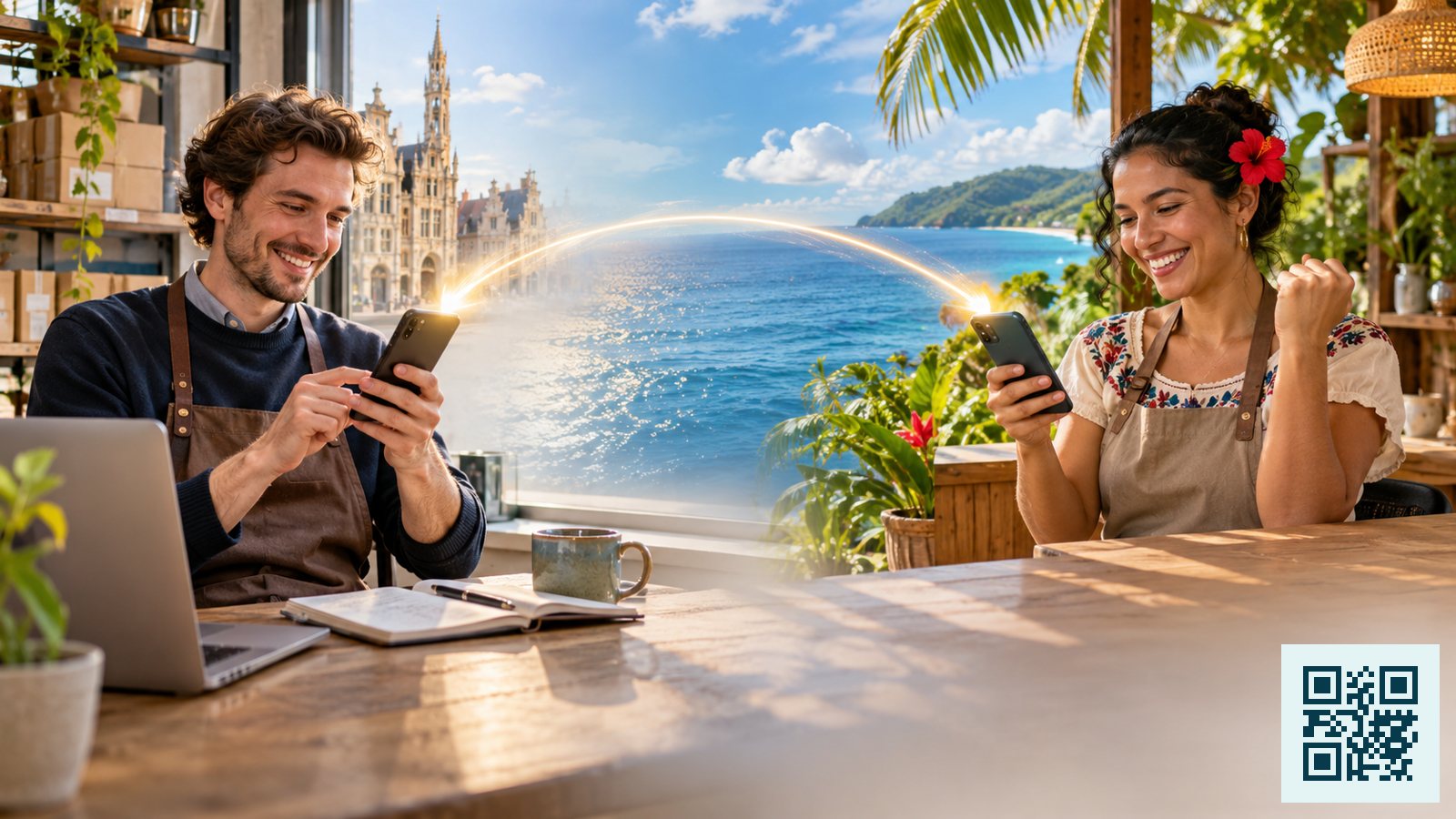
I do not expect every country to adopt one currency. Costa Rica should be free to keep its colón. I would simply like to pay someone there as easily as I can pay someone across Europe.
Perhaps one day I will send a payment from the Netherlands and receive a message from Costa Rica before I put down my phone: It has arrived.
In 1976, a post-office clerk and a motorcycle courier could make that happen in an hour. In 2026, we have the means to do better.
Let us connect the systems—and make that ordinary payment ordinary everywhere.
Lees deze column in het Nederlands +
Waarom heeft mijn geld een paspoort nodig?
Hoe kon een telex en een motorfiets in 1976 sneller zijn dan een internationale bankoverschrijving in 2026?
Bekijk Adriana’s “The Money Protest Song” ↓ · 4 minuten 19 seconden
In 1976 moest ik regelmatig luchtvaartkantoren in andere Europese landen betalen. Soms verwachtte een kantoor in Parijs Franse francs, terwijl ik in Amsterdam Nederlandse guldens had.
Ik ging naar het postkantoor, vertelde hoeveel francs het kantoor moest ontvangen en betaalde het equivalent contant in guldens.
Het postkantoor stuurde een telex naar Parijs. Daar bracht een koerier op een motor de francs naar het luchtvaartkantoor.
Naar mijn ervaring kon de luchtvaartmaatschappij haar geld binnen een uur hebben. Ik gebruikte vergelijkbare regelingen honderden keren voor betalingen naar België, Groot-Brittannië, Duitsland en Frankrijk.
Geen smartphone. Geen bankapp. Alleen mensen, een telex en iemand die op een motor stapte.
Tegenwoordig stuur ik soms geld vanuit Nederland naar Costa Rica. Costa Ricaanse rekeningen hebben IBAN-nummers en mijn betalingen komen meestal binnen zes tot acht werkuren aan. Dat is veel sneller dan de internationale betalingen die ik me van vóór de invoering van IBAN in Costa Rica herinner.
Maar een IBAN is het adres van een rekening. Het is niet automatisch de weg waarlangs geld tussen landen wordt vervoerd.
Binnen Costa Rica verplaatst het eigen SINPE-systeem geld tussen rekeningen. In een groot deel van Europa maakt SEPA eurobetalingen eenvoudig. Tussen die gebieden moeten banken nog afspraken maken over het omwisselen van valuta, het overmaken en verrekenen van geld en regels die van land tot land verschillen. [1] [2]
Ik begrijp dat een bank niet simpelweg kan melden: “Het geld is er.” De ontvangende bank moet werkelijk worden betaald. Zij moet weten aan wie, fraude tegengaan en fouten kunnen herstellen.
Maar zulke problemen moeten toch worden opgelost, in plaats van steeds opnieuw als reden voor vertraging te dienen?
De techniek om snelle nationale betaalsystemen te verbinden bestaat al. De Bank voor Internationale Betalingen heeft er een plan voor ontwikkeld. Europa werkt aan verbindingen tussen zijn eigen snelle betaalinfrastructuur en systemen buiten Europa. Toch meldt een rapport van deze maand dat de verbetering voor klanten langzaam en ongelijk verloopt. [3] [4] [5]
Daarom heb ik een vraag aan overheden, centrale banken en de betalingssector:
Wat houdt jullie nu precies nog tegen?
Is een regel het probleem? Zeg ons dan welke afspraak ontbreekt. Ontbreekt een verbinding? Vertel wie die moet bouwen. Willen banken niet investeren? Leg uit hoe zij worden gestimuleerd om mee te doen.
Als ondernemer heb ik geen les nodig over de ingewikkeldheid van internationaal betalen. Voordat ik op verzenden druk, wil ik de totale kosten, de wisselkoers en het moment waarop de ontvanger het geld heeft weten.
Niet ieder land hoeft van mij dezelfde munt te gebruiken. Costa Rica mag zijn colón houden. Ik wil iemand daar alleen even gemakkelijk kunnen betalen als iemand elders in Europa.
Misschien stuur ik ooit vanuit Nederland een betaling en verschijnt er, voordat ik mijn telefoon neerleg, een bericht uit Costa Rica: Het is aangekomen.
In 1976 maakten een postbeambte en een motorkoerier dat binnen een uur mogelijk. In 2026 hebben we de middelen om het beter te doen.
Verbind de systemen en maak van een gewone internationale betaling iets gewoons.
Sources / Bronnen
- Banco Central de Costa Rica · SINPE and IBAN accounts
- European Payments Council · SEPA geographical scope and euro payments
- BIS · Nexus blueprint for linking instant-payment systems
- ECB · Eurosystem payment strategy, cross-border links
- FSB · 2026 progress report on cross-border payments
The 1976 account and the six-to-eight-business-hour transfers are Ad Latjes’s personal recollections and experience, not a general speed guarantee. The pictures are illustrations, not documentary photographs. Adriana Carmen is a virtual singer.
Free-to-download images
These illustrations include small color-adjusted QR codes pointing to https://va.cr/67.
Download JPG
Download JPG

Download JPG
Wear it. See these images on a T-shirt
Adriana Carmen · The Money Protest Song
Adriana asks the decision makers: “Why can’t we have one currency worldwide? Or at least one easy way to pay?” Her lead voice and a large choir turn the question into a hopeful call to connect payment systems.