Automatic translation of the English text. Humour and nuance may change. Choose English to restore the original.
Loading language selector…
Are Medicines a Human Right?
Imagine being told that a treatment could save your life.
The science exists. The medicine exists. Somewhere, a factory is producing it.
Then comes the second conversation.
Can you afford it?
That is a remarkable question to place between a person and their future.
We celebrate medical breakthroughs with headlines, awards and photographs of smiling researchers. We should. Developing effective treatments is an extraordinary human achievement.
But a breakthrough has not reached everyone simply because it has reached the market.
For a patient who cannot obtain the medicine, the locked pharmacy door may as well be the wall of a laboratory that has not discovered it yet.
The title is not only a moral question. United Nations guidance on the right to health includes access to essential medicines and affordable care. It gives us a reason to ask how those principles are put into practice.
The price of a pill is not the whole story
It is tempting to compare the selling price of a medicine with the cost of manufacturing a tablet and conclude that everything in between is profit.
That would be too simple.
Research, unsuccessful experiments, clinical trials, quality controls and reliable distribution cost money. Some treatments are also genuinely difficult to manufacture. Companies need a reason to invest in useful new medicines.
But recognising those costs does not mean accepting every price without asking questions.
What research was required? What public support contributed? Is there genuine competition? What does the health system actually pay after negotiations? Can patients receive the treatment when they need it?
WHO identifies affordability as essential to access, alongside problems such as shortages and unreliable supplies.
A medicine sitting on a shelf at a price nobody can pay is available in a rather theoretical sense.
A little like a lifeboat with a payment terminal.
Patents should reward discoveries
Patents can encourage invention by giving an inventor temporary protection from competition.
The difficult part is making sure that protection rewards useful innovation without becoming an obstacle course around an existing treatment.
One concern is “evergreening”: strategies involving additional patents or changes around an existing medicine that can delay competition without a corresponding therapeutic benefit.
Not every new formulation or additional patent is an abuse. A better delivery method or a genuinely useful improvement can matter to patients. Patent laws and standards also differ between countries.
The question is whether the protection serves a real advance—or mainly helps keep competitors waiting outside.
A patient should not need to understand a patent lawyer’s filing cabinet before finding an affordable treatment.
The taxpayer is already in the laboratory
Publicly funded science contributes important foundations for drug discovery.
One study of new medicines approved in the United States found links to publicly funded research across the medicines it examined. Much of that contribution concerned the underlying biology and drug targets, rather than the government paying every bill for developing the finished products.
Private development still matters. So does the public contribution.
That gives us a reasonable policy question: when public money helps make a discovery possible, should funding and licensing agreements include clear plans for affordable access?
We can discuss how to do that without pretending that either taxpayers or companies work alone.
The public should receive more than a thank-you note it cannot redeem at the pharmacy.
Six ways to open more doors
Reward meaningful innovation. Design patent policies to encourage useful discoveries while protecting public health. Make the rules clear, and use the safeguards available under international agreements where appropriate.
Challenge abusive evergreening. Examine additional patent claims carefully and address practices that delay competition without worthwhile benefits. Preserve incentives for improvements that genuinely help patients.
Expand quality-assured competition. Support affordable generic medicines and, where appropriate, biosimilars. Competition needs effective regulation, dependable production and procurement that avoids relying on a single fragile supplier.
Fund research around medical need. Support public and nonprofit development alongside private research. Build access conditions into public funding and licensing arrangements, and give neglected diseases a place on the research agenda.
Use AI, and ask who receives the savings. AI may help analyse biological data, identify promising compounds and improve parts of development. Test its results carefully. Faster discovery does not remove the need for safety checks or automatically produce lower prices.
Cooperate across borders. Countries can share information, negotiate or purchase together where suitable, and support licensing arrangements that widen access. Fair pricing should support both affordable treatment and a reliable supply.
These are policy choices to develop and evaluate, not a promise that one reform will solve every problem.
But they give governments something more practical to discuss than whether patients should simply try being less ill.
Another way to develop medicine
Nonprofit development is not just an idea for a future conference.
The Drugs for Neglected Diseases initiative, known as DNDi, brings public, private, academic and other partners together to develop treatments around patients’ needs, with access and affordability built into its approach.
Such organisations do not make research free or guarantee that every project will succeed.
They demonstrate that commercial market size does not have to be the only starting point for deciding which diseases deserve attention.
A disease does not become less serious because the people affected have little purchasing power.
And what about artificial intelligence?
AI offers possibilities throughout drug development. It can help researchers search through information and investigate promising directions.
But a computer proposing a molecule has not yet delivered a safe, effective medicine to a patient.
Experiments, clinical evidence, regulatory scrutiny and manufacturing still matter.
There is a second question too.
If AI eventually lowers development costs, will the saving reach patients and health systems? Or will we simply get a more efficient route to an expensive product?
The software cannot decide that for society.
We need agreements, competition, public-interest research and purchasing policies that connect scientific progress with access.
Imagine the pharmacy in two thousand and seventy-six
This is a possibility worth working towards, not a prediction.
A patient receives a diagnosis. The health team identifies an effective treatment. Reliable manufacturers supply it, and a fair financing system means that obtaining it does not require selling the family home.
Researchers are rewarded. Safety standards remain demanding. Useful new treatments continue to appear.
The difference is that affordable access was part of the plan from the beginning.
That would be progress worth celebrating.
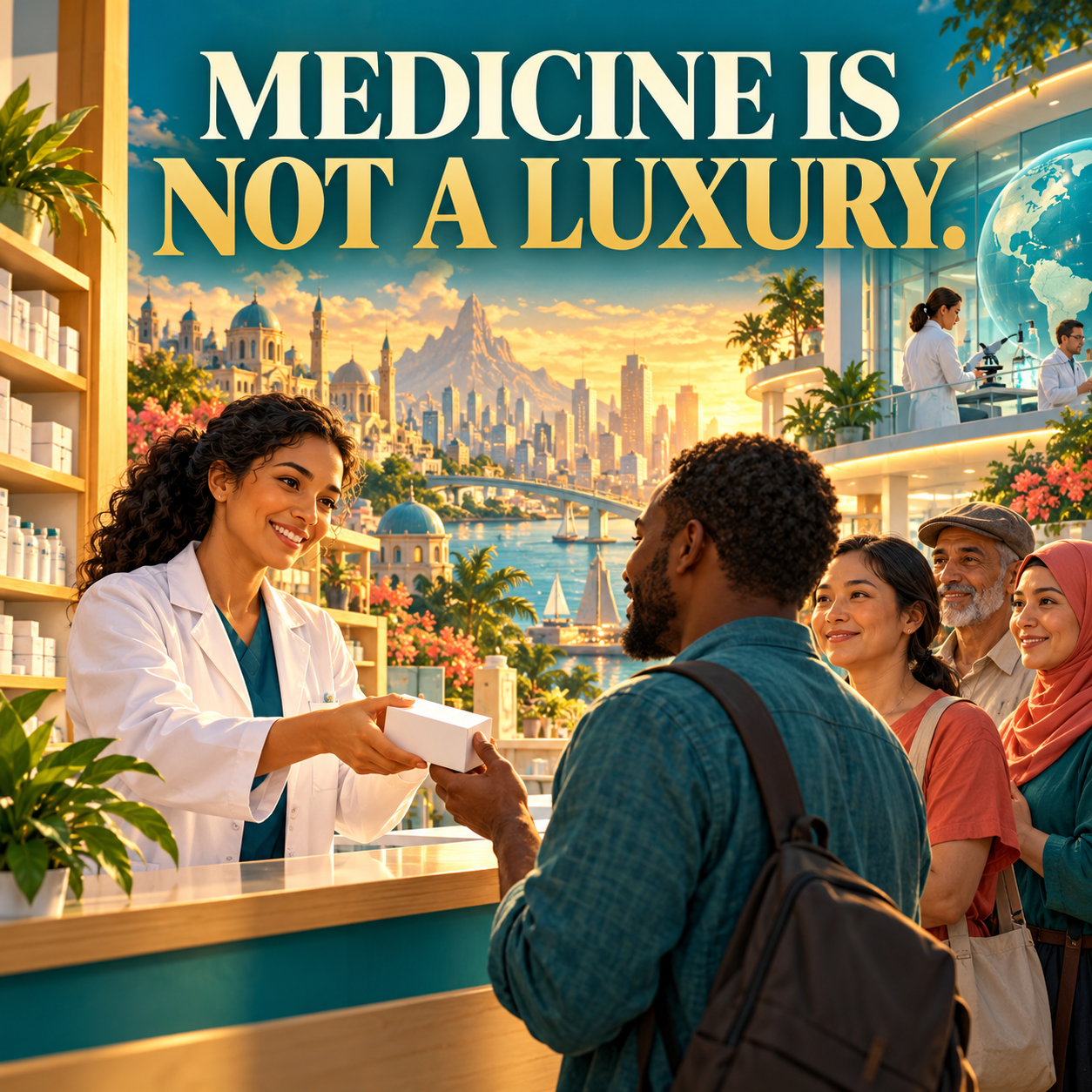
Medicine should not become a luxury product. A person’s income, birthplace or insurance status should not determine whether they can obtain lifesaving care.
We do not lack every tool needed to improve the system. We already have science, public research, capable manufacturers and examples of cooperation.
What we need is the determination to use them together.
A medical breakthrough becomes a human breakthrough when people can actually benefit from it.
The medicine exists. Let us make access possible too.
Zijn medicijnen een mensenrecht?
Stel je voor dat je hoort dat een behandeling je leven kan redden.
De wetenschap bestaat. Het medicijn bestaat. Ergens produceert een fabriek het.
Dan volgt het tweede gesprek.
Kun je het betalen?
Dat is een opmerkelijke vraag om tussen een mens en zijn toekomst te plaatsen.
We vieren medische doorbraken met krantenkoppen, prijzen en foto’s van lachende onderzoekers. Terecht. Werkzame behandelingen ontwikkelen is een buitengewone menselijke prestatie.
Maar een doorbraak heeft nog niet iedereen bereikt zodra het product op de markt is.
Voor een patiënt die het medicijn niet kan krijgen, lijkt de gesloten deur van de apotheek verdacht veel op de muur van een laboratorium dat het nog niet heeft ontdekt.
De titel is niet alleen een morele vraag. Richtlijnen van de Verenigde Naties over het recht op gezondheid omvatten toegang tot essentiële medicijnen en betaalbare zorg. Dat geeft ons een reden om te vragen hoe die uitgangspunten in de praktijk worden gebracht.
De prijs van een pil vertelt niet het hele verhaal
Het is verleidelijk om de verkoopprijs van een medicijn te vergelijken met de productiekosten van een tablet en alles daartussen winst te noemen.
Dat zou te eenvoudig zijn.
Onderzoek, mislukte experimenten, klinische studies, kwaliteitscontroles en betrouwbare distributie kosten geld. Sommige behandelingen zijn bovendien werkelijk ingewikkeld om te produceren. Bedrijven hebben een reden nodig om in nuttige nieuwe medicijnen te investeren.
Maar die kosten erkennen betekent niet dat we iedere prijs zonder vragen hoeven te accepteren.
Welk onderzoek was nodig? Welke publieke steun droeg bij? Is er echte concurrentie? Wat betaalt het zorgstelsel na onderhandelingen werkelijk? Krijgen patiënten de behandeling wanneer zij die nodig hebben?
De Wereldgezondheidsorganisatie noemt betaalbaarheid essentieel voor toegang, naast problemen zoals tekorten en onbetrouwbare levering.
Een medicijn dat op de plank ligt voor een prijs die niemand kan betalen, is op een nogal theoretische manier beschikbaar.
Een beetje zoals een reddingsboot met een betaalautomaat.
Octrooien horen ontdekkingen te belonen
Octrooien kunnen uitvindingen stimuleren door een uitvinder tijdelijk tegen concurrentie te beschermen.
De uitdaging is ervoor te zorgen dat die bescherming nuttige vernieuwing beloont, zonder een hindernisbaan rond een bestaande behandeling te worden.
Een van de zorgen is “evergreening”: strategieën met aanvullende octrooien of wijzigingen rond een bestaand medicijn die concurrentie kunnen vertragen zonder een overeenkomstig therapeutisch voordeel.
Niet iedere nieuwe formulering of ieder aanvullend octrooi is misbruik. Een betere toedieningsvorm of werkelijk nuttige verbetering kan belangrijk zijn voor patiënten. Ook verschillen octrooiwetten en beoordelingscriteria per land.
De vraag is of de bescherming een echte vooruitgang dient—of vooral helpt om concurrenten buiten te laten wachten.
Een patiënt zou niet eerst de dossierkast van een octrooijurist hoeven begrijpen om een betaalbare behandeling te vinden.
De belastingbetaler staat al in het laboratorium
Publiek gefinancierde wetenschap legt belangrijke fundamenten voor de ontdekking van medicijnen.
Een onderzoek naar nieuwe geneesmiddelen die in de Verenigde Staten werden goedgekeurd, vond bij alle onderzochte middelen verbanden met publiek gefinancierde wetenschap. Een groot deel daarvan betrof de onderliggende biologie en aangrijpingspunten voor medicijnen, niet een overheid die alle rekeningen voor het uiteindelijke product betaalde.
Private ontwikkeling blijft belangrijk. De publieke bijdrage ook.
Dat leidt tot een redelijke beleidsvraag: als publiek geld een ontdekking mede mogelijk maakt, moeten financierings- en licentieafspraken dan duidelijke plannen voor betaalbare toegang bevatten?
We kunnen bespreken hoe dat moet, zonder te doen alsof belastingbetalers of bedrijven het alleen doen.
Het publiek verdient meer dan een bedankbriefje dat je niet bij de apotheek kunt inwisselen.
Zes manieren om meer deuren te openen
Beloon betekenisvolle vernieuwing. Richt octrooibeleid zo in dat het nuttige ontdekkingen stimuleert en de volksgezondheid beschermt. Maak de regels duidelijk en gebruik waar passend de waarborgen die internationale afspraken bieden.
Pak misbruik van evergreening aan. Beoordeel aanvullende octrooiaanvragen zorgvuldig en bestrijd praktijken die concurrentie vertragen zonder waardevolle voordelen. Houd ruimte voor verbeteringen die patiënten werkelijk helpen.
Verbreed betrouwbare concurrentie. Steun betaalbare generieke medicijnen en, waar passend, biosimilars. Concurrentie vraagt om goed toezicht, betrouwbare productie en inkoop die niet afhankelijk is van één kwetsbare leverancier.
Financier onderzoek vanuit medische behoeften. Steun publieke en non-profitontwikkeling naast privaat onderzoek. Neem voorwaarden voor toegang op in publieke financiering en licenties en geef verwaarloosde ziekten een plaats op de onderzoeksagenda.
Gebruik AI en vraag wie de besparing krijgt. AI kan helpen biologische gegevens te analyseren, veelbelovende stoffen te vinden en delen van de ontwikkeling te verbeteren. Toets de resultaten zorgvuldig. Sneller ontdekken maakt veiligheidscontroles niet overbodig en leidt niet automatisch tot lagere prijzen.
Werk over grenzen samen. Landen kunnen informatie delen, waar passend gezamenlijk onderhandelen of inkopen en licentieafspraken steunen die de toegang vergroten. Eerlijke prijzen moeten zowel betaalbare behandeling als betrouwbare levering ondersteunen.
Dit zijn beleidskeuzes om uit te werken en te beoordelen, geen belofte dat één hervorming ieder probleem oplost.
Maar ze geven overheden iets praktischers om te bespreken dan de vraag of patiënten misschien kunnen proberen minder ziek te zijn.
Een andere manier om medicijnen te ontwikkelen
Non-profitontwikkeling is niet alleen een idee voor een toekomstige conferentie.
Het Drugs for Neglected Diseases initiative, bekend als DNDi, brengt publieke, private, academische en andere partners samen om behandelingen vanuit de behoeften van patiënten te ontwikkelen. Toegang en betaalbaarheid zijn onderdeel van die aanpak.
Zulke organisaties maken onderzoek niet gratis en garanderen niet dat ieder project slaagt.
Ze laten zien dat de omvang van een commerciële markt niet het enige uitgangspunt hoeft te zijn om te bepalen welke ziekten aandacht verdienen.
Een ziekte wordt niet minder ernstig omdat de mensen die eraan lijden weinig koopkracht hebben.
En kunstmatige intelligentie dan?
AI biedt mogelijkheden in de ontwikkeling van medicijnen. Ze kan onderzoekers helpen informatie te doorzoeken en veelbelovende richtingen te onderzoeken.
Maar een computer die een molecuul voorstelt, heeft nog geen veilig en werkzaam medicijn bij een patiënt afgeleverd.
Experimenten, klinisch bewijs, beoordeling door toezichthouders en productie blijven belangrijk.
Bovendien is er een tweede vraag.
Als AI de ontwikkelingskosten uiteindelijk verlaagt, komt die besparing dan bij patiënten en zorgstelsels terecht? Of krijgen we vooral een efficiëntere route naar een duur product?
Die beslissing kan de software niet voor de samenleving nemen.
We hebben afspraken, concurrentie, onderzoek in het publieke belang en inkoopbeleid nodig die wetenschappelijke vooruitgang verbinden met toegang.
Stel je de apotheek in tweeduizendzesenzeventig voor
Dit is een mogelijkheid om naartoe te werken, geen voorspelling.
Een patiënt krijgt een diagnose. Het zorgteam vindt een werkzame behandeling. Betrouwbare fabrikanten leveren die en een eerlijk financieringssysteem zorgt ervoor dat de patiënt daarvoor niet het gezinshuis hoeft te verkopen.
Onderzoekers worden beloond. De veiligheidseisen blijven streng. Er verschijnen nieuwe, nuttige behandelingen.
Het verschil is dat betaalbare toegang vanaf het begin onderdeel van het plan was.
Dat zou vooruitgang zijn die het vieren waard is.
Medicijnen mogen geen luxeproduct worden. Iemands inkomen, geboorteplaats of verzekeringsstatus zou niet mogen bepalen of levensreddende zorg bereikbaar is.
We missen niet alle hulpmiddelen om het systeem te verbeteren. We hebben al wetenschap, publiek onderzoek, bekwame fabrikanten en voorbeelden van samenwerking.
Wat we nodig hebben is de vastberadenheid om die samen te gebruiken.
Een medische doorbraak wordt een menselijke doorbraak wanneer mensen er werkelijk van kunnen profiteren.
Het medicijn bestaat. Laten we toegang ook mogelijk maken.
Watch: Are Medicines a Human Right?
The original English-language episode of World Problems, Future Solutions. About five minutes. Hosted directly on AIcolumns.nl.
The video loads when requested; it does not autoplay. English captions are available in the player and were automatically transcribed. Download the video · Back to the English column ↑ · Naar de Nederlandse column ↑
Factual context for the video / Feitelijke context
The video is an opinion piece. Additional patents do not reset an original patent’s term, although separate patents and other exclusivities can delay competition. Generic price reductions vary. Public research and private investment both contribute to development. AI may improve parts of discovery and development, but it does not remove the need for experimental evidence, clinical testing or regulatory review. Lower discovery costs do not automatically mean lower medicine prices. The written column above explains these distinctions.
De video is een opiniestuk. Aanvullende octrooien verlengen de oorspronkelijke octrooitermijn niet automatisch, maar afzonderlijke octrooien en andere exclusiviteitsrechten kunnen concurrentie vertragen. Prijsdalingen door generieke middelen verschillen. Zowel publieke wetenschap als private investeringen dragen bij. AI maakt experimenten, klinische studies en beoordeling niet overbodig. Lagere ontdekkingskosten leiden niet vanzelf tot lagere medicijnprijzen. De column hierboven legt die verschillen uit.