Future Scenarios for Global Problems That Matter
October 23, 2026
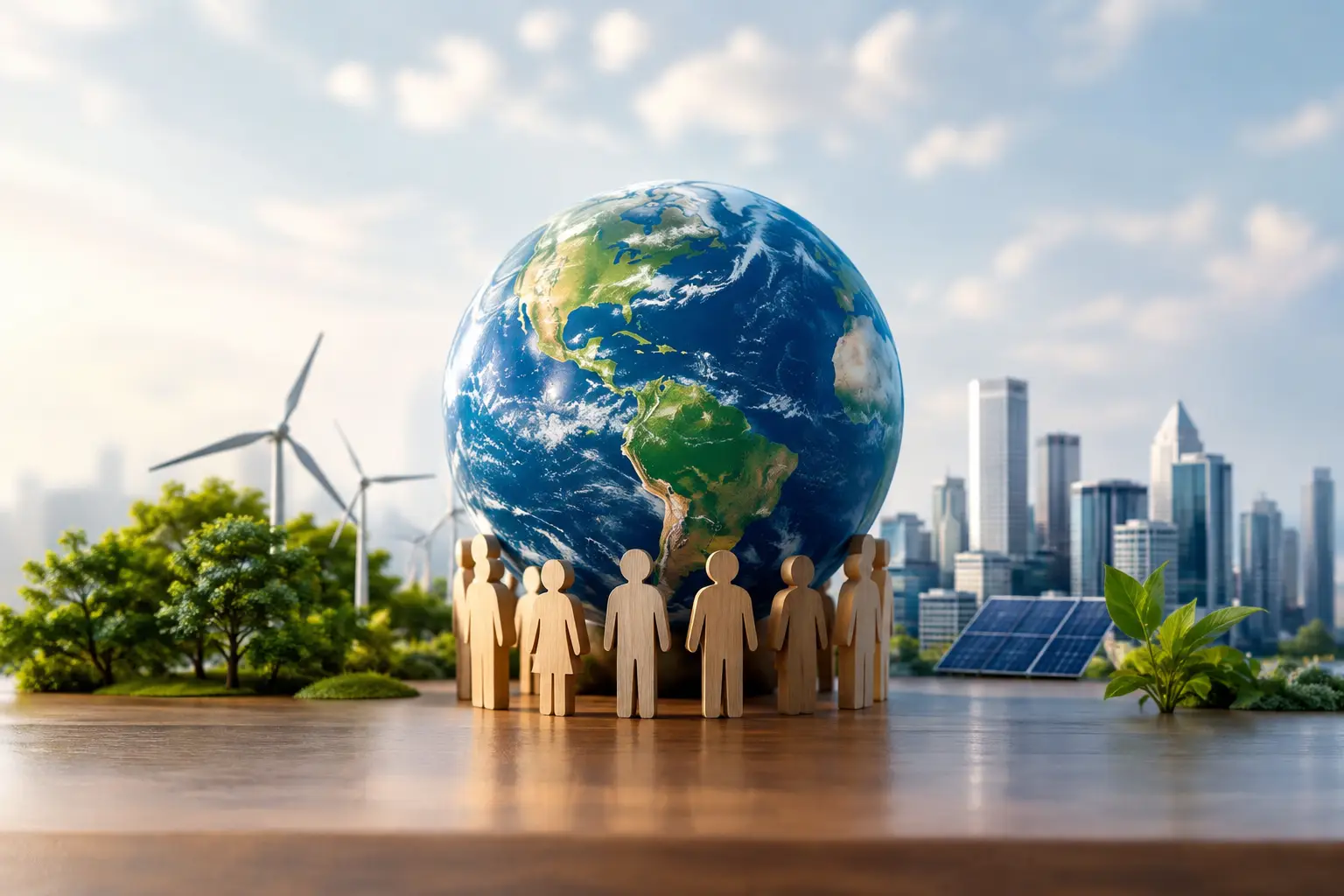
A flooded subway station, an elderly care home short of staff, a supermarket shelf with rationed rice, and an AI system deciding who gets a mortgage: none of these scenes requires a Hollywood budget. They are useful starting points for future scenarios for global problems because they force a question that headlines often avoid: what do we do next Tuesday morning?
The future is not a timetable hanging in some ministry hallway. It is a messy negotiation between demographics, technology, money, weather, elections, human laziness, and the occasional genius who ruins everyone else's spreadsheet. Scenario thinking does not tell us what will happen. It shows what could happen if certain choices, incentives, and blind spots continue to collide.
That distinction matters. A prediction invites spectatorship. A scenario asks for responsibility.
Why future scenarios for global problems are useful
We tend to discuss global problems as if they arrive separately, politely taking a number at the counter. Climate change is in one folder, migration in another, aging in a third, and artificial intelligence somewhere on a server that nobody can locate when the board meeting starts.
Reality is less organized. A drought can raise food prices, destabilize a region, increase migration, strain housing, and hand political entrepreneurs a very profitable megaphone. AI can make public services faster, but it can also concentrate power, reduce entry-level jobs, and make an already anxious society feel that the floor has acquired wheels.
Scenarios are valuable because they make these connections visible. They are not forecasts dressed up in a nicer blazer. A good scenario is a disciplined "what if?" It identifies a few forces that are genuinely uncertain, follows their consequences, and tests where institutions, businesses, and households might fail.
The goal is not to guess the winning lottery numbers for 2040. The goal is to avoid being surprised by consequences that were visible all along.
Four futures worth arguing about
The most useful scenarios are neither cheerful brochures nor disaster pornography. They should be plausible enough to make us uncomfortable and concrete enough to reveal choices.
1. The managed transition
In the most hopeful scenario, governments do the dull work before a crisis turns it into an emergency. Energy grids are expanded, homes are insulated, water use is priced sensibly, and food systems become less dependent on a small number of vulnerable crops and transport routes.
AI is used where it has a clear public benefit: reducing paperwork in health care, spotting energy waste, helping teachers tailor lessons, and detecting fraud. It is not treated as a mystical creature that must either save civilization or be locked in a basement with the Wi-Fi unplugged.
Migration remains politically difficult, but countries distinguish more honestly between asylum, labor shortages, family reunification, and illegal exploitation. Housing construction catches up with population growth. That last part may sound less glamorous than a moon base, but people cannot live in a policy paper.
The trade-off is obvious. This future demands investment now, more building, clearer rules, and politicians willing to explain that every serious solution annoys someone. Wind turbines upset views, new homes upset neighbors, higher carbon prices upset drivers, and training budgets upset anyone who prefers a tax cut with a ribbon on it.
2. The fortified patchwork
A second scenario is not total collapse. It is, in some ways, more recognizable: a world that keeps functioning, but unevenly and nervously.
Wealthier regions protect themselves with better infrastructure, tighter borders, private insurance, local energy systems, and expensive climate adaptation. Those who can afford resilient homes, reliable health care, and retraining have options. Those who cannot are told to be flexible, which is a lovely word when spoken by someone with three pensions.
Food still reaches stores, but prices swing more wildly. Heat waves make some jobs physically dangerous. Insurance retreats from flood-prone areas. Cities compete for skilled workers while struggling to house teachers, nurses, and police officers.
In this future, AI widens the gap unless rules and education keep pace. The best tools go first to the companies and countries already ahead. Smaller organizations become dependent on systems they cannot inspect and cannot negotiate with. Convenience rises, but so does quiet powerlessness.
This scenario is plausible precisely because it requires no dramatic villain. It grows from delayed decisions, short election cycles, and the old human habit of fixing the roof only after the living room has become a swimming pool.
3. The backlash decade
Every major transition creates winners, losers, and people who are told they are neither but somehow feel poorer. If climate measures, automation, housing pressure, and migration are handled without fairness or explanation, backlash becomes a governing force.
The backlash scenario produces simpler slogans and more complicated damage. Nations subsidize familiar industries indefinitely, restrict trade, block housing projects, and treat every foreigner as either a threat or an economic unit. Both views are lazy. Human beings remain inconveniently human.
Technology does not disappear. It becomes more politicized. Some citizens demand total surveillance for safety; others reject useful digital systems because they no longer trust who operates them. Public institutions lose capacity just when coordinated action is needed most.
There is a legitimate warning inside this scenario. People do not resist change merely because they are sentimental or misinformed. They resist when they carry the costs while someone else collects the gains. A climate policy that punishes a low-income commuter but ignores high-emission luxury consumption is not bold. It is simply asking for trouble.
4. The adaptive local revival
The most interesting future may be less centralized than either technocrats or populists expect. National governments still matter, as do international agreements. But much of the practical adaptation happens closer to home.
Cities redesign streets for heat and flooding. Regions coordinate housing, transport, and workforce training. Farms use less water and diversify crops. Employers hire older workers differently instead of pretending that experience expires at 62. Neighborhood care networks reduce loneliness and take pressure off formal services.
This is not a romantic return to village life, complete with artisanal bureaucracy. Local action can be parochial, inefficient, and captured by the loudest person in the room. Yet it has one advantage: people can see whether it works. A cooler schoolyard, a functioning bus line, or a new apartment building is harder to dismiss than a distant promise about national competitiveness.
The condition is that local experimentation must be matched by national standards and international cooperation. A municipality cannot solve sea-level rise alone, and a country cannot stabilize the climate by congratulating itself on its recycling bins.
The question behind every scenario
The central question is not whether the world will become better or worse. It will become better for some people, worse for others, and stranger for nearly everyone. The real question is who gets to prepare, who absorbs the risk, and who is invited into the decision before the bill arrives.
That changes how we should judge solutions. A proposal deserves more than applause if it sounds innovative. Ask what it costs, who administers it, what behavior it rewards, and what happens when it fails. Ask whether it still works outside a conference hall and after an election.
For businesses, this means treating long-term risks as operational concerns rather than a decorative paragraph in an annual report. For governments, it means investing in capacity: competent public services, grids, schools, housing, data safeguards, and emergency systems. For citizens, it means refusing the comfortable fantasy that complexity excuses passivity.
A better use of uncertainty
Uncertainty is often sold as a reason to wait. We do not know exactly how fast sea levels will rise, which jobs AI will reshape, or where the next food shock will begin. True. We also do not know exactly when our car will need repairs, yet most of us understand the wisdom of not driving on bald tires.
The sensible response to uncertainty is not panic or paralysis. It is preparation that remains adjustable. Build systems with room to adapt. Avoid decisions that create irreversible harm. Spread risks instead of concentrating them. And do not confuse a loud opinion with a plan.
A future scenario earns its keep when it makes us notice a choice we still have. That is the encouraging part, even if encouragement occasionally arrives wearing a hard hat and carrying an invoice.